Executive summary
Nordstrom did not leave downtown San Francisco for a single reason. The evidence points to a stacked-cause decision: a long erosion in downtown demand after the pandemic, weak office re-occupancy and tourism recovery, sharply lower mall foot traffic and sales, lease expirations that gave Nordstrom a clean exit, and real public-safety and street-condition concerns that made a weak store environment even harder to operate. In my judgment, the primary driver was demand destruction at this specific downtown location rather than a broad retreat from California or from physical retail generally. Confidence: high.
The closure involved two Nordstrom properties in the downtown core: the full-line Nordstrom at 865 Market Street inside San Francisco Centre, at Fifth and Market near Powell Street Station, and the nearby Nordstrom Rack at 901 Market Street. Local reporting and official planning records frequently place the flagship within the broader Union Square/downtown retail ecosystem even though the store sat on the Market Street edge of that district.
Nordstrom’s own public explanation centered on how downtown San Francisco had changed and how that hurt customer traffic and store viability. Westfield was blunter and tied the departure to unsafe conditions and weak enforcement. The best synthesis is that crime and disorder were important aggravators, but the heavier underlying cause was that too few shoppers were coming downtown, and too few were coming into the mall. That is why the strongest evidence in the record is traffic, sales, tourism, office, and lease data.
What happened and where the evidence is strongest
The flagship closure is best understood as a downtown-mall economics problem, not merely a “crime story” and not mainly a “Nordstrom corporate retrenchment story.” San Francisco Centre’s owner said mall sales fell from $455 million in 2019 to $298 million in 2022, while foot traffic dropped from 9.7 million visits in 2019 to 5.6 million in 2022. After Nordstrom left, the mall was projected to be only 55% leased, versus an average of 93% across other U.S. Westfield malls. Those are systemic indicators of an anchor location that had become structurally weaker.
The downtown environment around the store had also changed in ways that matter directly to department-store economics. In May 2023, the San Francisco Chronicle reported downtown office attendance at roughly 40% of pre-pandemic levels, and Powell Street BART exits connected to the mall were less than half of pre-pandemic levels. An official San Francisco Transportation Authority study later found weekday trips to/from/within downtown were down 46% from 2019 to 2023, and the share of downtown workers telecommuting two or more days per week rose from 14% to 63% over that span.
Tourism and conventions were still materially below 2019. San Francisco Travel estimated 23.1 million visitors in 2023, up from 2022 but still 11% below 2019; direct visitor spending reached $8.8 billion, still 8% below 2019 in nominal terms; and meetings-related spending in 2023 remained 31% below 2019. For a large urban flagship that depends on office workers, tourists, and convention spillover, that matters a great deal.
At the same time, local data does support a real safety problem. The Chronicle found San Francisco’s shoplifting reporting rate in 2021 was above the statewide rate, and Westfield explicitly blamed unsafe conditions and weak enforcement. But the same article also showed that 911 calls at Fifth and Market had fallen sharply versus 2019, which suggests that lower foot traffic was part of the picture and complicates any single-cause crime explanation. That is one reason I weight safety as a major contributing factor, but not the sole or dominant one.
Timeline and documentary record
The key dates show that the site’s issues predated the final closure announcement. In late 2019, San Francisco Planning approved conversion of up to 49,999 square feet on the upper floors of 865 Market Street from retail and related space to office use. An extension was approved in 2021. That does not prove Nordstrom was already doomed, but it is strong evidence that the landlord was already looking for a different use mix at the property before the post-pandemic collapse had fully played out.
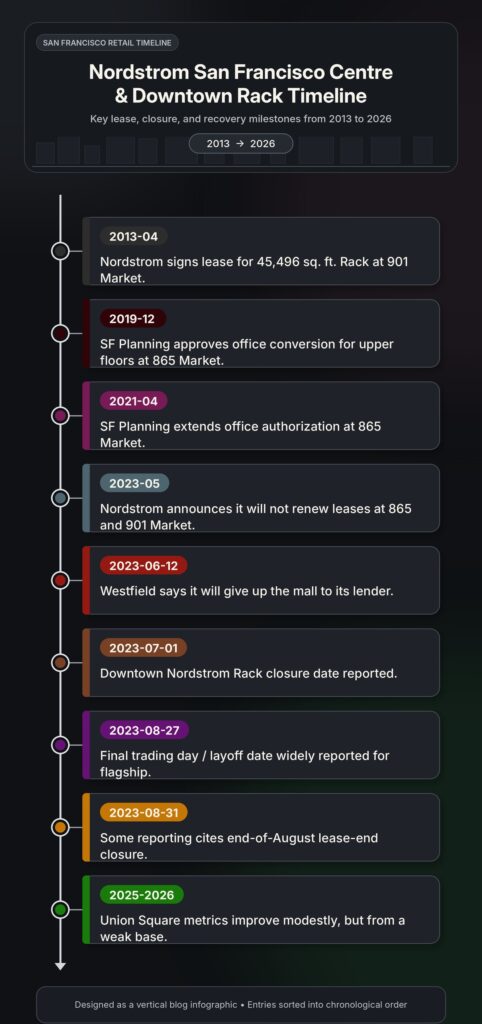
The dates in the timeline come from Nordstrom’s 2013 Rack lease announcement, San Francisco Planning documents, and local reporting in 2023. The Rack at 901 Market was announced by Nordstrom in 2013 under a 45,496-square-foot lease. In May 2023, Nordstrom said it would not renew the leases for its downtown full-line store and its nearby Rack. Most reporting places the Rack closing on July 1, 2023. For the flagship, there is a small date ambiguity: the best evidence suggests August 27, 2023 was the final customer/trading day and employee separation date, while some articles cite August 31 or “end of August,” likely reflecting lease-end or month-end treatment.
A concise event table is below.
| Event | What happened | Why it matters |
|---|---|---|
| Rack lease signed | Nordstrom announced a 45,496 sf lease for 901 Market in 2013. | Shows the downtown footprint was once expansionary. |
| Upper-floor repurposing | SF Planning approved conversion of up to 49,999 sf at 865 Market to office use in 2019, then extended it in 2021. | Suggests the landlord already saw excess retail capacity before the final closure. |
| Closure announcement | Nordstrom said in May 2023 it would not renew at the flagship and the Rack. | The decision was framed as a lease nonrenewal, not an abrupt eviction or bankruptcy-type event. |
| Rack closure | Local reporting placed the downtown Rack closure on July 1, 2023. | Confirms the closings were staged. |
| Westfield loan default | In June 2023, Westfield and Brookfield stopped paying on the mall’s $558 million loan and surrendered management to the lender. | Confirms deep property-level distress around the same time. |
| Flagship closure | Public reporting places the final customer day around August 27, 2023, with some reports citing August 31/end of August. | Minor date uncertainty, but not substantive uncertainty about the closure itself. |
Official statements and filings
Nordstrom’s most cited explanation was that downtown San Francisco had changed in ways that damaged store traffic and made the stores harder to operate profitably. Local reporting quoted the company as saying the downtown market had changed dramatically over several years, hurting customer foot traffic and its ability to operate successfully. A local-TV summary of Nordstrom’s statement added that, because both leases were expiring, the company believed it could serve Bay Area customers better through nearby stores and online.
Westfield’s statement went further. According to multiple local reports, the landlord tied Nordstrom’s departure to deteriorating downtown conditions, unsafe conditions for customers and staff, and weak enforcement against criminal activity. Just over a month later, Westfield and Brookfield also walked away from the mall loan, saying operating conditions had driven declines in sales, occupancy, and foot traffic. That sequence matters because it shows the owner’s own financial actions aligned with its public claims that the property itself was under severe stress.
Nordstrom’s SEC disclosures support the idea that this was a real estate portfolio adjustment inside a broader store fleet, but they do not give San Francisco-specific narrative detail. In its fiscal 2023 Form 10-K, Nordstrom reported total retail store count and square-footage activity showing 18 closures in fiscal 2023, with total square footage decreasing from 33.693 million to 32.381 million. The filing does not name the San Francisco store explicitly in the closures table, but it confirms meaningful store rationalization in that year. The same filing also says Nordstrom did not believe any then-identified legal proceeding would have a material impact on results, which is relevant because it suggests there was no disclosed company-level legal dispute specific to the San Francisco closure in SEC reporting.
One important negative finding: I did not find a standalone Nordstrom press release devoted specifically to the San Francisco closure in the official Nordstrom press room during this review. The company’s explanation appears to have been distributed mainly through direct statements and memos quoted by local media rather than through a formal press release page. That absence is itself a useful signal. It means the best “official” evidence is a mix of quoted company statements and SEC filings, not a long corporate narrative document.
Market, retail, and real-estate context
Commercial real-estate data around Union Square and the downtown core shows a weak, then slowly recovering, market. In Q1 2024, Cushman & Wakefield reported Union Square overall retail vacancy at 20.6%, direct vacancy at 18.4%, and premier ground-floor rents at $495 psf in Union Square, flat year over year. It also reported that average monthly Union Square visitors fell to 956,200 in Q1 2024 from 1.1 million in Q4 2023, and year-to-date visitors were down 9.0% year over year.
That weakness persisted through 2024. In Q4 2024, Cushman reported Union Square overall vacancy at 22.1% and direct vacancy at 19.7%, with premier rents still $495 psf in Union Square and $300 psf on Post Street. Total 2024 visitors were 12.7 million, down 5.5% from 13.4 million in 2023. This helps explain why the store’s closure should not be treated as a short-lived shock; the district remained soft well after Nordstrom left.
There was some improvement by 2025. In Q3 2025, Cushman reported Union Square overall vacancy easing to 22.7% from 23.0% in the prior quarter, with premier rents reaching $500 psf and average monthly visitors rising to 1.1626 million, up 3.0% year over year. That later recovery matters analytically because it suggests Nordstrom exited near the trough of the cycle. But it does not prove the closure was mistaken. It shows instead that the store faced a multi-year slump and left before the district showed only modest signs of stabilization.
The mall-specific data is even more striking than the broader district data. Westfield said San Francisco Centre sales dropped roughly 34% between 2019 and 2022, while mall foot traffic fell by more than 42%. Those are the kind of declines that can break the economics of a large department-store anchor, especially one occupying 312,000 square feet over multiple floors.
The downtown demand backdrop was also poor across sectors. San Francisco Travel’s 2023 report shows the city still below 2019 on visitors, visitor spending, and convention-related activity. A regional official summary of office occupancy said San Francisco only cracked the 60% mark on the busiest weekday in early 2024, which underscores how incomplete the return to office remained. And the official Downtown Travel Study found downtown trips had not remotely normalized. Those cross-sector indicators line up almost perfectly with Nordstrom’s own “foot traffic” explanation.
A compact market table helps show the arc.
| Indicator | Pre-pandemic / earlier benchmark | Around closure | Later reading |
|---|---|---|---|
| San Francisco Centre sales | $455M in 2019. | $298M in 2022. | Public owner data in this review did not provide a later comparable annual figure. |
| San Francisco Centre foot traffic | 9.7M visits in 2019. | 5.6M visits in 2022. | Post-default mall traffic remained weak; no later owner-issued annual figure was identified here. |
| Downtown trips | Baseline 2019. | -46% by 2023. | Transit recovery improved by 2025 but still lagged 2019. |
| SF visitors | 26.2M implied by 2023 being 11% below 2019. | 23.1M in 2023. | 2024–25 improved, but the closure decision was made before full tourism normalization. |
| Union Square rents | Not directly cited here for 2019. | $495 psf in Q1 2024. | $500 psf in Q3 2025. |
| Union Square overall vacancy | Not directly cited here for 2019. | 20.6% in Q1 2024. | 22.7% in Q3 2025 after earlier 2024 peak conditions. |
| Union Square visitors | 1.1M/month in Q4 2023. | 956,200/month in Q1 2024. | 1.1626M/month in Q3 2025. |
Legal, labor, and dispute review
The labor impact was immediate and well documented. The Chronicle, citing notices sent to California workforce regulators, reported that 333 employees at the flagship would lose their jobs effective August 27, 2023, and 46 employees at the downtown Rack would be affected effective July 1, 2023. The company said some workers could be offered transfers to other Nordstrom locations.
I did not find evidence in the reviewed SEC filing or the reviewed local coverage of a material Nordstrom-specific union dispute, strike, or landlord-tenant lawsuit that directly caused the closure. Nordstrom’s 2023 10-K says the company faced the ordinary run of claims and lawsuits that large retailers face, but did not identify any then-known matter expected to have a material impact. That does not mean there were no employee grievances or labor tensions at all. It means no material San Francisco closure dispute was evident in the filings or the main reporting reviewed here.
There was, however, a later tenant dispute that is highly relevant to the mall environment. In September 2023, American Eagle sued the mall’s owners, alleging neglect and more than 100 significant security incidents over roughly a year, including theft, violence, and customers brandishing firearms. That lawsuit was not about Nordstrom, but it strongly corroborates the argument that operating conditions in the mall had become difficult enough for tenants to turn to litigation.
The 2019 and 2021 office-conversion approvals also matter here. They are not “disputes,” but they are a form of documentary evidence that the real-estate strategy around 865 Market had already shifted away from pure retail and toward alternative uses before the final store closure. That makes the closure look less like an isolated shock and more like the culmination of a longer repositioning problem.
Assessment of contributing factors
My weighted assessment is below.
| Factor | Assessment | Weight | Confidence |
|---|---|---|---|
| Collapse in downtown foot traffic from pandemic aftershocks, remote work, and weaker tourism/convention demand | This is the strongest explanatory factor. Nordstrom cited foot traffic directly; official and local data on downtown trips, office attendance, transit, tourism, mall sales, and mall visits all point in the same direction. | Very high | High |
| Lease expirations and choice not to renew | The company framed the closure as a nonrenewal. That matters because it lowered the friction of exit. A store in a weak market can stay open longer if the lease compels it; once the lease rolls, economics matter more. | High | High |
| Safety, street disorder, and retail crime | Important, but best understood as an amplifier. Westfield stressed unsafe conditions. Crime data showed real shoplifting pressure. Yet falling 911 calls and weak foot traffic suggest safety concerns interacted with a low-activity environment rather than fully substituting for it. | Moderate to high | Medium-high |
| Mall-specific distress and tenant exodus | Also central. Westfield itself defaulted. The mall’s occupancy, sales, and traffic all deteriorated, and the loss of an anchor in a troubled center can become self-reinforcing. | Moderate to high | High |
| Broader Nordstrom corporate optimization | Secondary. Nordstrom was still opening stores elsewhere in California, which weakens any claim that the company was simply abandoning the state or brick-and-mortar retail. SEC filings confirm fleet changes, but not a California retreat. | Moderate | Medium |
The most rigorous reading is this: if downtown San Francisco foot traffic, tourism, and office-use patterns had returned close to 2019 levels, Nordstrom probably would have had a much harder choice to make at lease renewal. Safety problems still might have mattered, but they would not have been acting on top of such weak demand. That is why I see the closure as primarily a demand-and-location economics decision, with public safety as a meaningful but not stand-alone cause.
My concise conclusion is therefore:
Primary reasons
- Reduced customer demand at this downtown site because of remote work, weak convention/tourism recovery, and much lower downtown/mall foot traffic.
- Lease expiration and nonrenewal, which gave Nordstrom the practical opportunity to leave.
- Safety and disorder concerns, which worsened customer perception and operating friction in an already weak trade area.
- Property-level distress at San Francisco Centre, including falling sales, falling visits, and later loan default.
Overall confidence: High on the first two reasons, medium-high on the safety weighting, and high that this was a multi-causal decision rather than a one-variable event.
Source guide and reliability
The citations in the table link to the underlying source pages.
| Source | Type | What it contributes | Reliability |
|---|---|---|---|
| Nordstrom 2023 Form 10-K | Primary, SEC filing | Store-count/square-footage closures in FY2023; legal proceedings disclosure. | Very high for corporate facts disclosed to investors. |
| San Francisco Planning documents for 865 Market | Primary, local government | Exact property, 2019 office-conversion approval, 2021 extension. | Very high for property/use-history facts. |
| Nordstrom 2013 Rack lease announcement for 901 Market | Primary, company press release | Rack address and leased square footage. | Very high. |
| San Francisco Travel 2023 visitor/spending report | Primary, destination research | Visitor volume, spending, convention/meeting recovery. | High. Methodological estimates, but official destination data. |
| SFCTA Downtown Travel Study and summary | Primary, transportation agency | Downtown trips, telecommuting, transit recovery. | High. |
| Cushman & Wakefield MarketBeat reports | Industry/CRE research | Union Square rents, vacancy, visitor counts, market trend. | High for market benchmarking, though produced by a brokerage and should be read as professional market research, not government statistics. |
| San Francisco Chronicle reporting on the closure, crime/safety, layoffs, and Westfield default | Local reporting | Best local synthesis of causes, dates, WARN impacts, mall distress. | High. |
| California Globe closure report | Local reporting / commentary-leaning outlet | Useful for dates and quoted statements, but stronger editorial framing than the Chronicle. | Medium. Better for supplementary context than for sole support. |
| San Francisco Business Times public snippet/social preview | Local business reporting, indirect access | Limited confirmation of end-of-August timing in a public snippet; direct article access was blocked in this session. | Medium because only a snippet was available. |
| Later reporting on American Eagle’s lawsuit | Secondary/local reporting | Corroborates difficult mall conditions after Nordstrom’s exit. | Medium-high for the existence and allegations of the suit. |
I specifically looked for SF Examiner coverage because you asked for it. Direct retrieval of Examiner articles was blocked in this session, so I did not use Examiner content for load-bearing factual claims. That is a limitation of this report.
Open questions and limitations
A few uncertainties remain. First, the flagship’s exact “closure date” varies by source: the best evidence indicates August 27, 2023 was the final trading/layoff date, while some reports cite August 31 or “end of August,” probably because lease-end and last-day-open were not always distinguished.
Second, there is no single publicly available Nordstrom press release in this review that narrates the closure in one place. The official record is fragmented across quoted company statements, SEC filings, and local reporting. That is why this report relies on triangulation rather than one dispositive corporate memo.
Third, Union Square market reports are a proxy for the flagship’s location. They are highly relevant, but the store sat at Fifth and Market inside San Francisco Centre, not directly on the Union Square plaza. So the district-level vacancy and rent numbers should be read as close context, not as a perfect one-to-one measurement of the flagship box itself.
Even with those limitations, the main conclusion is stable: Nordstrom closed because downtown demand at that location had become too weak to justify renewal, and safety/disorder concerns made that weak demand environment even less workable.